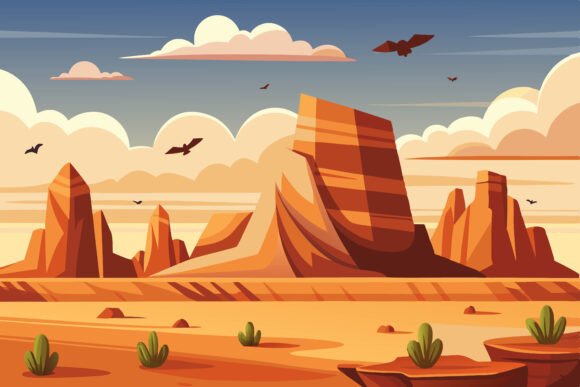
Colored Desert Landscape: A Modern Visual Asset for Designers and Storytellers
Striking images of arid, sun-drenched terrain have quietly become one of the most versatile tools in a visual creator’s arsenal. A colored desert landscape is more than a scenic backdrop; it represents a blend of warmth, openness, and narrative potential that resonates across print, web, and interactive media. Whether you’re building a brand identity, illustrating a blog post, or crafting an infographic, the right landscape illustration can communicate depth and emotion without a single word. In this piece, we explore why professionally crafted vector landscapes are gaining ground, how they align with current creative needs, and what makes an AI EPS illustration set a smart investment for designers, marketers, and business owners alike.
The Growing Creative Appetite for Natural Tones and Spacious Imagery
Over the last few years, visual trends have shifted toward warmer earth tones, minimalist composition, and a sense of escape. The colored desert landscape fits neatly into this movement. Designers working on wellness apps, eco-friendly branding, or travel campaigns often look for visuals that evoke calm, resilience, and a touch of adventure. Instead of shooting custom photography—which can be costly and logistically tough—an editable vector scene gives you full control over mood, palette, and composition.
This isn’t just about following a trend. The human eye responds to balanced color schemes and open space. In interface design, for example, a subtle desert-inspired hero image can reduce visual clutter while keeping the page engaging. Many content creators now pair such illustrations with bold typography to produce a modern, airy aesthetic that works across device sizes. The result is a design language that feels both contemporary and timeless, helping products and messages stand out in crowded feeds.
What’s worth noting is the move away from over-processed stock photos. Audiences today recognize staged imagery and often scroll past it. A hand-crafted illustration, on the other hand, signals intention and originality. When that illustration is built with the precision of Adobe Illustrator, it can be reshaped to fit any brief, from a tech startup’s landing page to a local café’s printed loyalty card. That kind of adaptability is exactly what forward-thinking creators seek.
Why Vector Format Changes Everything for Brand Assets
Raster images have their place, but a desert landscape delivered as an AI EPS bundle changes the entire workflow. Vector files allow infinite scaling without quality loss, so a design that looks crisp on a business card remains razor-sharp on a tradeshow banner. The files described in the Hello Welcome to our Special AI EPS Collections set come in both AI and EPS formats, along with a ready-to-use JPG preview. This dual-format support is essential for teams that move between Mac and Windows environments—no compatibility headaches, no missing fonts.
The real advantage shows up when you open the file. A neatly organized layer structure means you won’t waste time hunting for a specific cactus silhouette or that perfect sun-bleached rock formation. Every element is labeled and grouped logically. For a busy marketing manager who needs to swap a background color at 10 p.m. before a launch, that organization is invaluable. You can edit colors, reposition elements, and even repurpose individual icons without starting from scratch.
Consider a small agency creating a seasonal campaign. They might need to shift a warm terracotta desert palette to cooler midnight blues for a winter promotion. With an editable vector set, that transformation takes minutes, not hours. The editability also means teams can maintain visual consistency across multiple assets while adapting to different sub-brands or localized markets. In a climate where brands must pivot quickly, owning a flexible core illustration set reduces reliance on external resources and speeds up the go-to-market timeline.
How an AI EPS Illustration Set Streamlines Your Design Workflow
Time spent searching through scattered stock libraries adds up fast. When you buy a cohesive collection like the colored desert landscape pack, you get a unified style that guarantees consistency from the first slide to the final social media graphic. This matters because fragmented visuals can erode brand trust. An organized file structure—where desert dunes, textured mountains, and botanical elements are kept on separate layers—lets you build custom compositions with a few clicks.
Practical examples abound. An infographic designer could pull a single agave icon from the set to use as a bullet point marker, then blend horizon line art into the report’s header. A web developer could export parts of the landscape as SVG bits for lightweight animation. Even a freelancer working on a client’s ebook cover can benefit from having high-resolution JPG previews immediately on hand for mockups, while saving the vector master for final tweaks.
Many professionals underestimate the mental overhead saved by a well-structured file. When every layer is named and color-coded, collaboration becomes smoother. A design lead can pass a file to a junior team member with clear instructions: “Adjust the sky gradient layer to match the updated brand guide.” The toolset becomes an extension of the team’s creative thought process, not a barrier to it. And because the collection is suitable for print, web, symbols, apps, and infographics, the same initial purchase keeps paying off across channels.
From Print to Digital: One Landscape, Endless Applications
A colored desert landscape isn’t limited to wall art. Its real power lies in cross-media versatility. Print designers use such vectors for brochures, event flyers, or even packaging for organic food products that want to suggest a natural, earthy origin. The high-resolution JPG included in the set works perfectly for immediate placement in InDesign layouts, while the AI file stays pure for any last-minute resize requests from the printer.
On the digital side, app interfaces and SaaS dashboards increasingly borrow natural motifs to humanize their user experience. A module that visualizes climate data, for instance, could be flanked by a subtle desert terrain at twilight, making the numbers feel connected to a real place. Similarly, startup pitch decks often need evocative imagery that won’t distract from key metrics—a muted, colored desert horizon does exactly that. These landscapes also lend themselves to social media templates, where consistent imagery across posts can immediately signal a theme, whether it’s a motivational quote series or a travel journal blog.
Even beyond traditional commercial design, educational materials benefit. Geography presentations, environmental eBooks, or mindfulness workshop handouts can all integrate these visuals to hold attention and reinforce the subject. The fact that you can modify colors and shapes means a science teacher could adapt the same landscape to illustrate different climate zones over a semester. That kind of reuse stretches a modest design investment into something genuinely practical.
What to Look for in a Professional Illustration Set
Not every vector pack delivers the same value. When evaluating a collection like the one featured here, consider five key factors that separate a time-saver from a time drain:
- Cross-platform compatibility. The files must open flawlessly on both Mac and Windows, which AI and EPS formats guarantee. No surprise error messages when handing off to a colleague on a different system.
- Organized layering. A flat, single-layer file might be quick to download but becomes a nightmare to customize. Look for a set that boasts neat, named layers so you can isolate exactly the element you need.
- Attention to detail. Perfection in details shows in the quality of line work, the smoothness of gradients, and the overall composition. High-quality desert landscape sets include subtle nuances like desert varnish on rocks or vignette shadows, which elevate the final output.
- Consistency across elements. If you pull a rock formation from one scene and a cactus from another, they should look like they belong together. Consistency in style and line weight means you can mix and match freely.
- Ease of editing. Beyond just changing colors, you should be able to scale, rotate, and combine components without distortion. The best sets treat every icon and landscape element as a building block, not a locked whole.
When a product markets itself as being “suitable for print, web, symbols, apps, infographics” and promises that “you can edit it, change colors and modify the icon so easily,” it’s essentially offering a design toolkit, not a static picture. This promise, when backed by solid file architecture, directly addresses the modern need for speed without sacrificing polish.
Making the Most of Your Desert Landscape Vector Kit
Once you have the files, start by exploring the layers. Open the AI file and toggle visibility on individual groups to see how the artist built the scene. This small exercise often sparks ideas for your own projects—maybe you’ll decide to extract just the desert sky gradient for a website header, or isolate a row of distant mesas for an email footer.
Don’t limit yourself to the original color scheme. The ability to easily recolor means you can align the landscape with any brand palette. A financial services firm might go for cool greys and muted teals; a yoga studio might prefer soft peaches and dusty pinks. Both can use the same base illustration without the end results looking alike. This makes the set a long-term asset rather than a one-project download.
Collaborate across roles. Copywriters and content strategists benefit from having a visual idea to anchor a story. Show them how the dunes can become a metaphor in a narrative, and you’ll likely get more cohesive campaigns. Even non-designers can use the included JPG for simple presentation backgrounds or social posts, saving everyone time. The key is to treat the illustration set as a shared language that bridges the gap between concept and execution.
As with any tool, the value grows with use. Bookmark the folder in your team’s shared drive. Create a quick style guide that shows the default and a few alternate color treatments, so anyone can drop in the right version at a moment’s notice. Over weeks and months, you’ll notice how often a well-crafted colored desert landscape solves a visual gap—whether it’s adding warmth to a white paper, softening a tech-heavy slideshow, or giving a local business’s signage a memorable focal point.
Connecting Visual Assets to Real-World Outcomes
It’s easy to treat illustrations as decorative add-ons, but in practice, they carry weight. An investment in a high-quality, editable vector set often translates into faster turnaround, more cohesive brand materials, and a consistent visual signature that audiences come to recognize. For small business owners who handle their own marketing, the ability to quickly adjust a landscape for a seasonal sale banner without hiring outside help is a tangible cost saving. For agencies, having a go-to resource for nature-inspired graphics means one less variable in a tight production schedule.
The intersection of art and efficiency is where many creators now operate. Stock subscriptions offer quantity but rarely the precision or flexibility of a thoughtfully composed AI EPS collection. What makes this particular desert landscape set stand out is the combination of aesthetic quality and practical file construction. It’s built for real-world conditions—tight deadlines, multiple revisions, and the need to scale across both print and digital without losing integrity.
Designers, marketers, educators, and entrepreneurs alike can appreciate a resource that removes friction from the creative process. As we move further into a visually driven communication era, having a reliable library of editable landscapes isn’t just convenient; it’s a way to stay agile and maintain a professional edge. So if you’re looking to add a versatile, warm, and thoroughly modern set of visuals to your toolkit, exploring well-organized vector collections like the one described here could be your next practical step.